
Curly and Afro Hair Care
How to Care for Curly and Afro Hair in Ghana’s Climate
Aug
Curly and Afro Hair in Ghana’s Climate can require a different approach to hair care. Heat, humidity, strong sun, sweat and seasonal changes can affect how your hair retains moisture, how your curls behave and even how long your styles last.
A routine that worked perfectly in another country may not give you the same results here. And even if you have always lived in Ghana, understanding how the climate affects your hair can make caring for it much easier.
At Nappytalia, working with Curly and Afro Hair in Ghana every day has taught us one important thing: there is no universal routine. Healthy hair starts with understanding what your hair actually needs.
Curly and Afro Hair in Ghana’s Climate: What Your Hair Needs
1. Make Hydration a Priority
Curly and Afro hair naturally tends to struggle with moisture retention because the scalp’s natural oils have a harder time travelling along the bends and coils of the hair.
In Ghana’s heat, dryness can become even more noticeable, particularly when hair is exposed to sun, air conditioning, dust or frequent manipulation.
A good Curly & Afro Hair Care routine should include regular conditioning and a leave-in product to help maintain moisture. If your hair still feels dry shortly after applying products, however, simply adding more product may not solve the problem. Your routine, technique or product combination may need adjusting.
2. Keep Your Hair and Scalp Clean
Afro hair doesn’t need to be washed every day, but avoiding shampoo for very long periods isn’t necessarily healthy either.
Heat, sweat, dust, natural oils and styling products can all create buildup on the scalp.
How often you cleanse depends on your scalp, lifestyle and hairstyle. The important thing is finding the right balance between keeping your scalp clean and avoiding unnecessarily harsh cleansing that leaves your hair feeling stripped.
3. Adapt Your Routine to Ghana’s Seasons
Ghana’s climate changes throughout the year, and your hair may not need the same routine in every season.
During the rainy season, higher humidity can contribute to frizz, shrinkage and make some styles harder to maintain.
Harmattan brings a different challenge. The combination of dry air and dust can leave both the hair and scalp feeling noticeably drier, making moisture retention particularly important.
Pay attention to how your hair changes throughout the year and adjust your cleansing, conditioning, moisturising and styling routine accordingly.
4. Protective Styles Still Need Hair Care
Braids, cornrows and twists can reduce daily manipulation, but protective styling doesn’t mean forgetting about your natural hair.
Your scalp still needs to be cared for, your hair shouldn’t be subjected to excessive tension, and styles shouldn’t be kept indefinitely.
A protective style should actually protect the hair underneath it. If a style is excessively tight, causes discomfort or contributes to breakage, it is no longer serving that purpose.
5. Learn What Your Hair Actually Needs
Curl typing can be useful, but knowing whether you have 3C, 4A, 4B or 4C hair doesn’t tell you everything.
Porosity, density, strand thickness, previous damage, lifestyle and how your hair retains moisture are equally important. This becomes especially relevant with Curly, Afro & Mixed-Texture Hair, where different textures can exist on the same head.
Instead of only asking “What is my curl type?”, pay attention to how your hair actually behaves.
When Should You See a Curly & Afro Hair Specialist?
If your hair remains extremely dry, breaks easily, is becoming increasingly difficult to detangle, or you simply don’t know which routine works for you, professional guidance can help.
At Nappytalia Salon in Accra, our Curly & Afro Hair Specialists work with curly, Afro and mixed-texture hair. Our approach starts with understanding the individual hair in front of us rather than applying the same routine to everyone.
→ Book your visit at Nappytalia Salon
Curly & Afro Hair Products for Ghana’s Climate
A good routine doesn’t necessarily require a long list of products. What matters is choosing products according to what your hair needs.
For hair struggling with dryness and moisture retention, your routine may include:
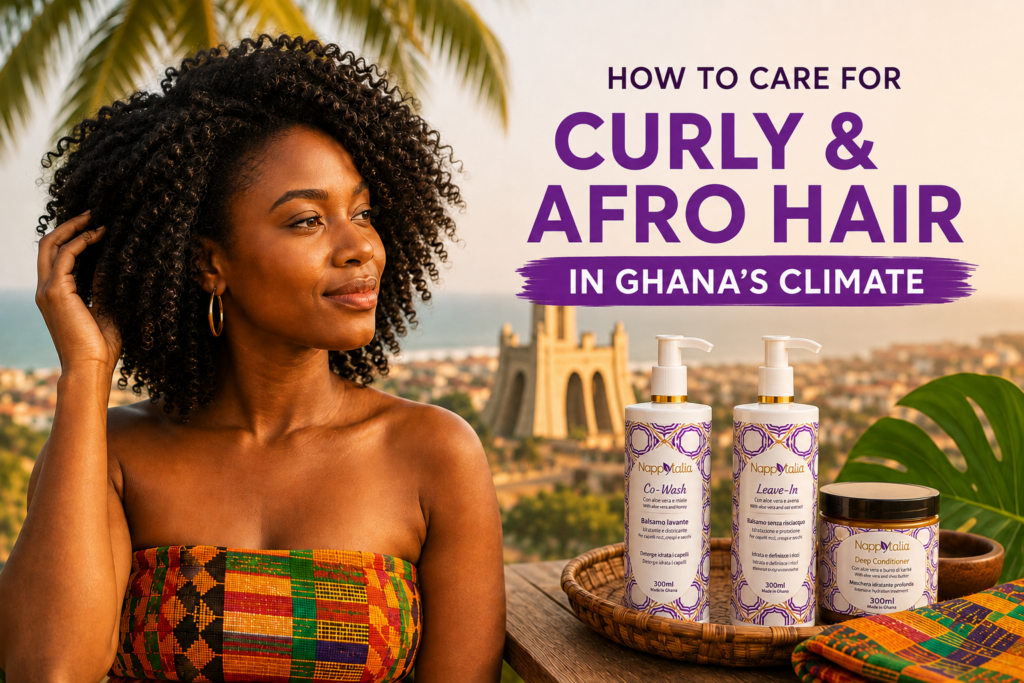
- Co-Wash for gentle cleansing and conditioning
- Leave-In Conditioner for daily moisture and easier detangling
- Moisturizing Mask for deeper conditioning
- Gel Idrariccio for curl definition and styling
Nappytalia Curly & Afro Hair Products are developed for curly, Afro and textured hair and are Made in Ghana.
→ Discover Nappytalia Curly and Afro Hair Products
Frequently Asked Questions
Does Ghana’s humidity affect curly and Afro hair?
Yes. Higher humidity can contribute to frizz, shrinkage and shorter-lasting styles. How strongly your hair reacts depends on its texture, porosity, condition and the products used.
Why does my hair feel drier during Harmattan?
Harmattan brings very dry air and dust, which can make curly and Afro hair feel particularly dry. During this period, conditioning and moisture retention may need more attention.
How often should Afro hair be washed in Ghana?
There is no universal schedule. How often you cleanse depends on your scalp, lifestyle, activity level and hairstyle. The goal is to keep the scalp clean without unnecessarily stripping the hair.
Do I need different products during Ghana’s rainy season and Harmattan?
Not necessarily completely different products, but you may need to adjust how much moisture, conditioning or styling support your hair needs as humidity and dryness change.
Understanding Your Hair Is the First Step
Caring for Curly & Afro Hair in Ghana doesn’t have to mean using ten different products or following a complicated routine.
Keep your scalp clean, prioritise hydration, minimise unnecessary manipulation and pay attention to how your hair responds to Ghana’s changing climate.
The better you understand your hair, the easier it becomes to give it what it actually needs.
